Could a collection agency build predictive pairing in-house?
A collection agency with a data team could build its own predictive pairing. The question is whether it would beat paying for it. An in-house build needs a data pipeline, models kept current, daily assignments, a control group every month and a standing team to run them, all paid for by one agency. Buying starts with a $15,000 fixed fee for the Floor Assessment, credited against later fees. Live pairing then costs the greater of 10% of the extra collected against a control group and $2,500 a month.
New to BestPair? See what it is and how it works
What does an in-house pairing build take?
Six parts. The first five are the system; the sixth is what keeps it working after the build is finished.
- A data pipeline. Call records, payments, the collector roster and account details, joined and cleaned every day. Payments can land weeks after the call, in the collection system rather than the dialer, so each one has to be tied back to the account and credited to a collector by a rule the floor chooses. Crediting payments to collectors.
- Models, rebuilt as results come in and as collectors join and leave.
- Daily assignments that respect each collector’s capacity and the floor’s existing routing rules, including licensing and client rules.
- Delivery to the floor, as daily lists or as segments in the dialer’s router, without breaking existing routing. If your platform already runs predictive routing on its queues, how platform predictive routing differs.
- Measurement against a control group every month, scored on dollars collected per account contacted.
- People to keep it right: someone for the data, someone for the models and someone who knows the dialer, kept on staff for as long as the system runs.
When does building make sense?
Building can be the right call. An agency that builds keeps every model and all of its data inside its own systems, with no outside vendor in the path, and it sets its own roadmap. In our view building makes most sense for an agency that:
- already runs a data and modelling team for scoring or analytics, so the people are in place;
- must keep all account data inside its own systems, by its own policy or a client’s;
- can hold a control group every month, for as long as the system runs, with someone senior who will defend it when results look good.
Why is the measurement the hard part?
A model can be built in-house. The harder thing to keep up is the test that shows whether it works. Accounts have to be split at random before anyone dials, both groups worked in the same weeks, and nobody allowed to move accounts between them, month after month. Once a supervisor moves a few good accounts into the new group, or the control group is dropped because results look good, the floor can no longer tell a gain from a good month. How to prove a routing change worked.
With BestPair, that test is written into the Order Form and both groups’ results are on every invoice. In our view an in-house team has to hold the same line with no contract to hold it to.
Is it cheaper to build or buy?
In our view, most of a build’s cost stays the same whether the floor is small or large: the pipeline, the models and the team are needed either way, and one agency pays for all of it. Price it as people kept on staff for years, not as a one-off project. The team costs the same in a month when it finds nothing.
Buying starts with the Floor Assessment, a $15,000 fixed fee, credited against Stage 2 fees above the $2,500 minimum. Live pairing then costs the greater of 10% of the extra collected against a control group and $2,500 a month. A month with no gap costs the minimum. Building a business case for agent matching sets out the arithmetic on your own numbers, and how agent matching is priced shows how to count the first year with the Floor Assessment in it.
Where should an agency start either way?
The first question is the same for a build and a purchase: how far apart are your collectors on the same kinds of accounts? A floor can look before deciding. Split last quarter’s results by the kinds of account your floor already reports on, and see whether the order of collectors changes. If it barely changes, pairing has little to work with, whoever builds it. Agent matching with similar collectors. Which account details you would need.
Common follow-up questions
Can we start with the assessment and build ourselves later?
Yes. The Floor Assessment report is yours to keep whatever you decide. It shows, as a range from your own history, how much more might have been collected if each account had gone to its best-fit collector. In our view that is the first thing an in-house team would need to know.
How long does an in-house build take?
It depends on the team an agency already has and how clean its call and payment data is, so we don’t put a figure on it. Plan for the part that never ends: models rebuilt as collectors join and leave, and a control group every month for as long as the system runs.
Our data has to stay in our own systems. Can we still buy?
Not from BestPair. The matching is calculated off-site by BestPair, on AWS in the United States, and does not run inside the agency’s own environment. Whether that is acceptable depends on your policy and your clients’ contracts. If either requires everything in-house, that is a reason to build. Where agent matching data is hosted, and who can access it.
Videos on this
See it on the main site
Two minutes
Watch the explainer
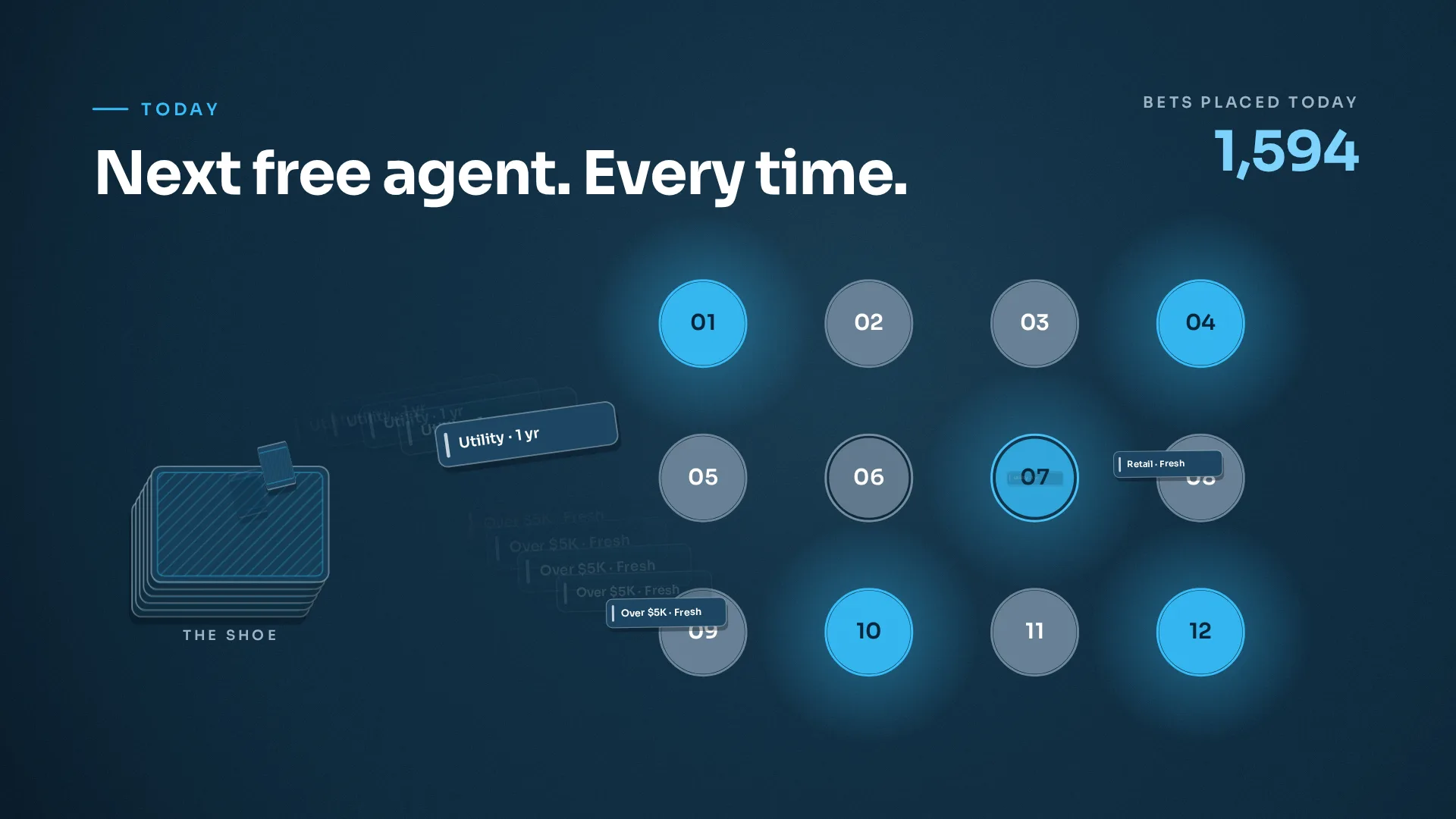
What happens to the next account today, what pairing changes, and what the Floor Assessment measures. With captions.
Watch the videoYour floor
Try the calculator
Three numbers off your dialer and collections reports give an illustrative figure for your floor. It is at best informed guesswork until your own history is measured.
Open the calculatorWhat you get
See the sample report
The report the Floor Assessment delivers, page by page, built on a fictional floor with synthetic data.
See the report
Would it be a bad idea to spend 45 minutes finding out?
If your shop does not qualify, you will hear it on the call, not after you have paid for a report.
Book a 45-minute fit call